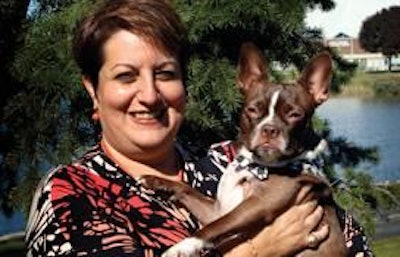
Yet for Robbie Dawg, standing out has never been a problem. “It’s the detail, from the packaging to the presentation to the flavors to the look of everything,” explains Lisa Fortunato, president of the organic treat company. “That’s what’s really important to us.”
Robbie Dawg started the way many small treat or pet food companies do: in the founder’s kitchen. In 2003, Fortunato, then an event planning and graphic design professional, decided to throw her dog a birthday party and couldn’t find the kind of organic dog treats she wanted for the goodie bags. So she baked her own, creating a recipe based on the lessons she had learned from her father: Always use fresh, wholesome ingredients and make everything from scratch.
The treats she made were such a hit with family and friends that Fortunato eventually decided to make them for sale. By December of that year, she was taking orders from stores in New York City. Since then, the company has grown by leaps and bounds: It outgrew its original facility in Brooklyn, New York, USA, and is in a temporary space while preparing to move to a new, larger facility. Fortunato has added a chief managing partner, John W. Hickey III, and has made such a mark with her treats that she’s now approached by other companies for contract baking.
Soon after that fateful doggie birthday party, Fortunato was laid off from her job. “At that point, I said, ‘I’m never working for anyone ever again,’” she says. “I made a list with 10 different things I could do. Somehow, I decided to become a manufacturer of dog biscuits!”
It was a timely decision. The New York International Gift Fair happened soon after, and Fortunato was able to research her business idea by walking the show. “I went to every single pet venue,” she says. “I did my homework. I knew I wanted to have a high-end product, organic from the very beginning. Certainly I believe we were one of the first companies that was organic.”
Fortunato applied what she learned to roll, cut and bake organic dog biscuits by hand in the 60-square-foot kitchen of her apartment. “It was all about the presentation. I designed the packaging, I did the flavor profiles,” she says. Product in hand, she started visiting local stores. “If I was able to meet someone who could make a decision, I always got an order.”
In spring 2004, wanting to validate her business concept, Fortunato exhibited at the H.H. Backer Annual Spring Pet Industry Trade Show, then in Atlantic City, New Jersey, USA. Robbie Dawg was obviously a success: “We still have about 40% of the same customers from that show,” Fortunato says.
Soon the company outgrew Fortunato’s kitchen. “It was either get a contract baker or become a manufacturer. And because organic was so new then and the ingredients were so expensive, and because it was my baby, I didn’t trust anyone else. I wanted to make sure everything was done in accordance to what I wanted,” she explains. So she refinanced her mortgage, found a former machine shop in Brooklyn and renovated the space. “We’ve been there until now, we’ve exploded to the point where we have to relocate to be able to fulfill orders.”
Again, Fortunato credits her company’s swift success partially to good timing. “It was just at that time, say 2005, when boutiques started to emerge and we were the perfect item, because it allowed us to segue-way into many different venues. It wasn’t just the pet boutique, it was home furnishing stores, lifestyle stores, a whole range from grocery to bigger stores to anywhere people go shopping. So that really allowed us to build up the number of stores,” she says.
But the biggest factor behind Robbie Dawg’s rapid growth is the product itself. “It’s the flavor profiles that people know us for,” says Fortunato. “Because it’s always the ‘mother’ of the dog doing the shopping, she’s attracted to the packaging. She’ll pick it up and say, ‘Ah, turkey sausage and romano cheese, that sounds really good. I like that flavor and therefore I’m going to buy it for my dog.’ She’ll take it home and the dog loves it, and now we have a customer.”
The flavors now number about 15, including the first, Peanut Butter and Carrot, still one of the company’s best-sellers; seasonal flavors such as Little Lulu’s Cranberry Crunch (named after Fortunato’s other dog, since Robbie had the company named after him); and even two flavors for cats.
Another popular product attribute is what Fortunato calls “snapability.” Robbie Dawg biscuits are free of wheat or gluten, which tends to make some dog biscuits heavy, she says. “Our biscuits are such that you can snap them easily. We make a little treat that looks like a piece of kibble and is scored into four, and you can actually snap it into the size of a kernel of corn. This helps whether it’s an older dog that’s losing its teeth, a little dog that the ‘mother’ thinks can’t chew, a larger dog you’re giving multiple pieces for training or an overweight dog that you want to give separate small treats rather than one big piece.”
Fortunato adds that all Robbie Dawg products are still handcrafted, baked fresh daily and also free of corn, soy, added salt, sugar, preservatives, flavors, dyes, colors or anything artificial. “Also, we use a rotary moulding cookie machine that has dies so you can have a very definitive design and definite shape; it's a look that is different because it's not extruded. The dough is almost like Play-Doh consistency. It goes into a hopper and gets pressed into the roller, then cut with a knife.”
With a fellow entrepreneur as a partner now to help her manage and chart the company’s growth, Fortunato sees many opportunities. “We feel there are other avenues to explore in the treat line: for instance, creating a soft treat that doesn’t have chemicals or preservatives, creating treats with probiotics or glucosamine that really do something,” she says, as opposed to products with functional ingredients that may lose their efficacy because of the high heat used during extrusion and other processing methods.
Not having a pet industry background, Hickey brings a renewed energy to the company, Fortunato says. “His vision is all new, and he’s excited, and he has that business sense to say, ‘Yes, this is the path, this is what we can achieve, this is what we can do.’ Because when you’re a small business and you’re doing it by yourself, you have to wear so many hats and it’s hard after a while.”
Yet it seems unlikely that Robbie Dawg will ever get too big. “I always like to say, it’s the smaller companies that change the world. They do something because they see a need for it,” Fortunato says. “And people want to know that there’s a face and a conscience behind a brand. We’re still the face and the conscience behind ours, and we always will be.”


