Rotisserie chicken, anyone? How about T-bone steak, turkey, beef pot roast, peanut butter or Thanksgiving feast?
These flavors might stimulate many people’s appetites, and dog owners think they’ll get their dogs’ mouths watering, too. That’s according to a survey of more than 1,000 dog owners conducted by McCormick Flavor Solutions in February 2025 and presented at Petfood Forum 2026 by Tiffany Fiore, senior product manager, and Susan Gallager, senior regulatory analyst, for the company. (The survey also included 1,000+ cat owners, but the presentation focused on the dog owner responses.)
McCormick has run the survey for seven years now, Fiore said, and each year they add new features and nuances. But one finding stands out: “78% of dog parents and 75% of cat parents agreed with the statement: ‘My own approach to feeding my pet is similar to my approach to eating,’” she explained.
6 flavor personalities
Not surprisingly, that approach includes focusing on features like health and nutrition, ingredients and label claims. McCormick added yet another new wrinkle with its latest survey, layering in flavor personalities derived from a quiz typically used on their “consumer and retail business side” (read: human food) about how each person eats, cooks (or doesn’t) and chooses flavors.
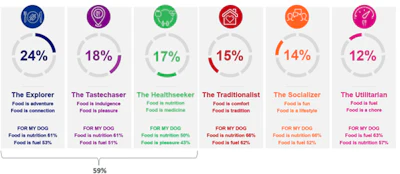
Fiore described the six personalities:
- Explorer — thinks of food as adventure and connection. These people love to cook and entertain at home.
- Taste chaser — food is all about taste, indulgence and trying new flavors. Much less concerned with ingredients, and more focused on the actual taste experience.
- Health seeker — food is nutrition and, intentionally, medicine. They tend to be picky eaters — discerning about what they put into their bodies based on ingredients, rather than leading with taste and flavor.
- Traditionalist — also very engaged with food and cooking, but tends to stick to what they know. Food is comfort and tradition for them.
- Utilitarian — for them, food is just fuel. They are the least engaged in cooking and least interested in trying new flavors.
- Socializer — food is fun; it’s a lifestyle. These are the foodies of the world — phone out at every restaurant, excited to engage with food and share it with others.
The majority of dog owners surveyed, an aggregate of 59%, fall into the first three categories, Fiore said, which influences how they feed their dogs. “For example, the health seeker is the least likely of all six flavor personalities to use flavor as a factor in their purchase decision — which makes complete sense,” she commented. “When they think about food for themselves, it’s not about taste; it’s about what’s good for the body.”
In addition, the health seeker dog owner over-indexes on two key dog food purchasing drivers. First, 80% of all dog owners surveyed agreed that they select foods for their dogs that they consider nutritious and a complete source of nutrition; for health seekers, that was 84%. Then, 68% of all dog owners agreed that when they buy new foods for their dogs, they read the product labels and ingredient statements before buying, vs. 73% for health seekers.
Humanization is here to stay
Other nuances emerge among the flavor personalities: For instance, the explorer is more likely to give their dog treats, 87% vs. 82% for all dog owners surveyed, and also more likely to feed wet food, 66% vs. 59%.
That 59% is up 11 percentage points over the 2024 McCormick survey, another indication of the overall shift in the market — though 91% of all dog owners surveyed are still feeding dry, which means more people seem to be adding wet food as a mixer or topper, perhaps mirroring the greater variety of formats we have in our own diets.
“This shows that consumers are genuinely interested in the humanization of pet food — not just in theory, which has been discussed for over a decade, but specifically in culinary-inspired formats that mirror what's on their own table,” Fiore concluded.