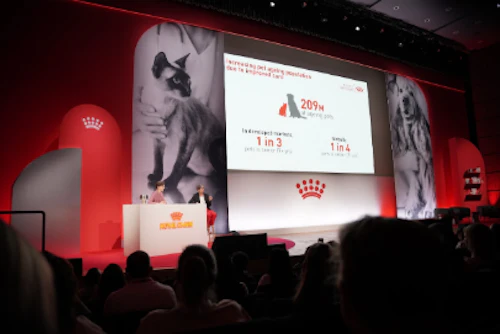
The U.S. cat supplement market represents a significant and underserved opportunity for manufacturers, according to new consumer research presented by Shannon Landry, research director, Packaged Facts Pet, at the recent 2026 NASC Annual Conference in Phoenix, Arizona.
Drawing on survey data from approximately 1,500 pet owners collected in January and February of this year, Landry outlined a market in transition — one where cat ownership is holding steady while dog ownership declines, and where cat owners are increasingly engaged in their pets' health and wellness.
A market in transition
The numbers tell a clear story. Of approximately US$156 billion in total U.S. pet product and service sales, cats account for roughly US$46 billion compared to US$104 billion for dogs. In pet food and treats alone, cat sales reach about US$22 billion versus US$46 billion for dogs.
But the gap may be narrowing with the trajectory favoring cats.
"After a pandemic-related bump, the dog population has experienced declines," Landry said. "The share of households that have a cat has kept steady. The same cannot be said for dog ownership."
Data from MRI Simmons, which surveys approximately 50,000 households, confirms the trend, explained Landry. Between 2019 and 2025, the share of cat-owning households tracked closely with overall U.S. household growth, while dog-owning households declined.
Several structural factors are driving this shift. Older pet owners are aging out of dog ownership: cats are smaller, easier to manage and better suited to smaller living spaces. Meanwhile, younger prospective pet owners face housing affordability challenges that make dog ownership impractical. Packaged Facts data shows renters are far more likely to own cats than dogs.
The shift shows up in adoption data, too. In 2019, kitten households represented about 66% of puppy households. By 2025, that figure had reached 99%, essentially a one-to-one ratio.
"With fewer puppies, there are fewer future dogs," Landry said. "This is one more reason the cat population is an important point of focus."
Cat owners are invested — and they feel underserved
Despite the market opportunity, cat owners say the industry isn't keeping up. When Packaged Facts asked whether cats are treated as "second-class citizens," a growing share of cat owners agreed, and that sentiment has worsened over successive survey waves.
"Cat owners feel that whoever is out there marketing these products, manufacturing these products, designing these products, they are not treating cats the way cat owners feel they should be treated," Landry said.
That frustration coexists with deep emotional investment. Packaged Facts data shows 91% of cat owners consider their cat part of the family, and 86% say their cat is central to their home life. Eighty-one percent keep cats in the family eating or living area, 60% keep their cat indoors full time, and 56% share their bed with their cat.
"The more time cat owners spend with their cats, the more likely they are to notice health and wellness issues," Landry said. "The more time that you spend with your pets, the more likely you are to be concerned about behaviors that might signal a health and wellness problem — and that's absolutely where pet supplements can come into play."
What cat owners want from products
When asked what drives their purchasing decisions, 72% of cat owners said they look for products that improve their cat's health and wellness, 70% want to make their cat's life more comfortable, and 51% are motivated by pampering.
About 20% of cat owners currently purchase supplements. The top purchase influence is veterinarians — a notable finding given that cat owners are less likely to visit the vet than dog owners, partly because cats are skilled at masking health problems and partly because vet visits can be stressful for cats.
According to Landry, the most popular supplement format among cat owners is the soft chew. Top conditions driving purchases include general overall health, probiotics and indoor pet health.
Market opportunities: where to focus
Landry identified several growth areas for supplement brands targeting the cat market.
Healthy longevity. More than half of cat-owning households include a cat over the age of 7. As those cats age, owners will increasingly seek products that support not just longer lives but better quality of life — maintaining activity levels and mental acuity.
Calming and anxiety. More than a third of cat owners reported their pet has anxiety, and about a quarter reported behavioral issues that can be linked to anxiety. "This is another area where cat owners may be looking for solutions and not necessarily finding them," Landry said.
Value propositions. Pet owners are pulling back on purchases they perceive as nonessential, and more than half are actively seeking discounts or promotions on supplements.
"It is of utmost importance that you show pet owners that pet supplements are not a nonessential — that they are an essential part of their pet's health and wellness routine," she said. "They want to know that what they're spending their pet dollars on is going to be beneficial to their pets." Landry emphasized that transparency around ingredients and efficacy are central to that value case.
Omnichannel and direct-to-consumer. Younger generations, particularly Gen Z and millennials, favor a single source for both pet products and services, a trend Landry described as the "omnimarket." Veterinary clinics are increasingly moving toward retail, and pet services are being integrated into brick-and-mortar retail environments.
"Someone marketing a product like pet supplements can't just focus on one area of sales," Landry said. "You've got to be aware of the other movements happening."
About 40% of pet owners have used direct-to-consumer purchasing in the past 12 months, though supplements lag behind pet food in that channel — an opening for brands willing to invest in DTC infrastructure. Similarly, autoship and subscription purchasing, which Landry noted essentially equates to guaranteed repeat sales, remains an underdeveloped channel for supplement brands.
Looking ahead
Packaged Facts projects cat product sales will grow faster than dog product sales across most categories over the next five years. The main risk to that trajectory would be macroeconomic shifts that make dog ownership more accessible — affordable housing, for instance — which could revive demand for dogs.
"There seems to be a pent-up demand for dog ownership among current non-dog owners," Landry noted, adding that if the economic factors currently constraining dog ownership ease, dog sales could recover. "Cat ownership, however, has been structurally stable regardless of economic conditions, suggesting the trend has staying power."
For supplement manufacturers that have historically underinvested in the cat segment, Landry's message was clear: the cat market is no longer a secondary consideration.