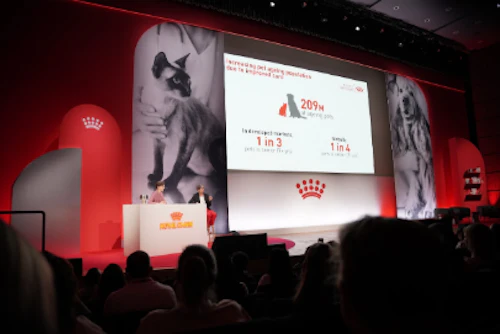
Nicole Hill, VP of Strategy and Innovation at MarketPlace, presented findings from Nextin's proprietary consumer research at the 2026 NASC Annual Conference in Phoenix, Arizona, drawing on data pooled from two surveys, one focused on dog owners, one on cat owners, totaling 2,414 U.S. respondents. The research segmented the market using 25 behavioral features, identifying where consumers fall in what Hill described as a pet supplement acquisition funnel.
"We want to understand what's coming, what's next, what do consumers want, what are the unmet needs and early signals that give us an idea of where the category is headed," Hill said.
The analysis found that 49% of pet owners are supplement prospects and 24% are current purchasers. The four segments — Wellness Disengaged, Interested Inactives, Adjacent Wellness Shoppers and Pet Supplement Adopters — each carry distinct implications for how brands should allocate marketing and product development resources.
1. Pet Supplement Adopters: retain and expand
Representing 32% of dog owners and 17% of cat owners, Pet Supplement Adopters are the market's current buyers and, Hill said, the starting point for any growth strategy.
"Your next sale is from your current customer," she said.
This group is defined by strong brand values alignment and a willingness to spend accordingly. Seventy-eight percent are sole decision-makers for their pet's health and nutrition, and 55% say they will pay more for pet consumables with sustainability attributes. Eco-friendliness (39%), cause-driven purchasing (32%), sustainably sourced ingredients (31%) and regenerative agriculture (30%) all over-index compared to the total market.
One in four in this segment agreed with the statement, "My dog eats better than I do" — a figure Hill called telling.
"It really sums up that they're willing to spend more on their pet, and they are proud of at least part of what they see as a signal of their care and affection," she said.
Purchase behavior reflects category depth: all respondents in this segment buy supplements, 49% buy dental products and 83% buy treats — with 52% of those treat purchasers selecting products they perceive to have functional benefits.
Hill flagged that last point as an ongoing education challenge for the industry. "Even though they are informed consumers who are purchasing supplements, there's still some motivation that causes them to purchase treats with that perception tied to them," she said. "Clarifying the difference between a supplement and a treat is really education that the broad pet owner audience needs at large."
Top purchase-driving need-states for this segment differ by species. For dogs, joint health, skin and coat, digestion and calming lead. For cats, digestion tops the list, followed by gut health, immunity and skin and coat. Hill highlighted cognitive health and eye health as emerging need-states worth watching — both are running at roughly double the market average among adopters, which she said signals broader market movement within two to three years.
Among ingredients, postbiotics showed particularly notable growth. "Postbiotics specifically has almost quadrupled in the past few years in terms of the positive associations that consumers have with it," Hill said. Other early-adopter ingredients in the 14-26% positive association range include turmeric, biotin, krill oil, elderberry and chondroitin.
Format and feeding habits also distinguish this group. Forty-three percent feed fresh pet food — refrigerated, frozen or shelf-stable — at 1.59 times the market average. Twenty-nine percent prefer powder or granule supplements that can be mixed into food, at 1.71 times the market average.
Hill's strategic recommendation for this segment: bundle.
"If you have a system, if you have a bundle, that's where you want to be," she said.
Multi-supplement portfolios, premium-tier products and subscription programs are the priority plays. She also pointed to a broader "wellness trifecta" concept — combining supplements, dental care and better-for-you treats into co-merchandised or bundled offerings — as an opportunity for brands looking to grow basket size.
2. Adjacent Wellness Shoppers: the conversion opportunity
Adjacent Wellness Shoppers — 24% of dog owners and 20% of cat owners — are the segment Hill identified as the clearest near-term growth opportunity. They are already investing in pet wellness through dental products, perceived-benefit treats and fresh food, but have not yet crossed into supplement purchasing.
"They're supplement ready,” she explained. “They just need to be pulled into the fold and educated.”
This group skews younger and higher-income: 34% are between the ages of 30 and 44, and 20% report household incomes of $100,000-$150,000. They share the value-driven spending profile of Pet Supplement Adopters, with strong over-indexes for eco-friendly (38%), sustainably sourced (34%) and cause-driven (33%) brand attributes. Forty-three percent agreed with the statement, "My dog goes everywhere I go."
Feeding habits signal premium engagement: 43% feed fresh pet food (1.57 times the market average) and 12% feed air-dried pet food (1.70 times the market average). Nearly half, 47%, spent more than an hour researching two or more pet health ingredients in the prior 12 months, with vitamins and minerals, probiotics, prebiotics, collagen and pumpkin topping the list.
The conversion barrier, Hill said, is primarily educational. Forty percent of Adjacent Wellness Shoppers have purchased treats they believed would deliver health benefits, and the opportunity lies in helping them understand what a supplement actually does differently.
"Helping this segment understand what they're getting from each thing — yes, a treat is a fantastic way to reward a pet or train a pet or just show them love, but supplements are also a fantastic way to show them love if they have a need state that supplements can address," Hill said.
Reaching this segment does not require new channels. Forty-four percent consult their veterinarian for information, though only 14% actually purchase from their vet. Eighty-three percent already shop via Amazon, Chewy, mass retail or pet specialty stores. Social media — particularly Facebook (25%), Instagram (23%) and X (14%) — also plays a meaningful role in where this group gets pet health information.
"If you're already in any of these, or all of these, then you're reaching 83% of this Adjacent Wellness Shopper audience," Hill said.
3. Interested Inactives: the long game
Interested Inactives make up 25% of dog owners and 30% of cat owners. They are benefit-interested but food-focused, meaning they may purchase food with wellness positioning but are not yet buying supplements, dental products or other wellness-oriented consumables.
Hill described this group as representing mainstream pet ownership and habitual purchasing: 45% of dog owners say their dog has eaten the same brand of food for most of its life, 64% take their dogs on walks, and 71% of cat owners have indoor-only cats. Twenty-seven percent describe their cats as sleepy or lazy — a behavioral cue Hill suggested could signal unaddressed health needs.
Price sensitivity is the defining constraint. Forty-one percent list affordable price among their top three pet food selection considerations, five points above the total pool average. Fewer than 20% are willing to pay more for any sustainability-related brand attribute — a sharp contrast with the two higher-engagement segments.
"Premium positioning is not going to resonate with this audience quite as much," Hill said. "Entry-tier or trial-size products, especially if they can be merchandised adjacent to food in some of those more familiar retail channels, is really going to be the way to educate and convert."
Unlike Adjacent Wellness Shoppers, this segment does not require a specific channel strategy so much as a messaging and pricing one. They largely track the total market average for information sources and retail channel usage, with veterinarians (46%), friends and family (33%) and online search (29%) leading as information sources.
"It's not so much about where you show up as what you say and what your price point is," Hill said. "Messaging and price point matter more than the medium for this segment."
Hill characterized Interested Inactives as a long-tail investment — worth cultivating for future category growth, but unlikely to convert quickly without a sustained awareness and education effort.
4. Wellness Disengaged: a cat-skewed signal
The Wellness Disengaged segment — 27% of the total sample — is not currently engaged in pet wellness purchasing of any kind. Hill noted cat owners are overrepresented here, making up 33% of the segment compared to 20% of dog owners.
"You can look at that and say, 'Oh, well, that means that cat owners aren't interested in supplements as much,' but you can also look at that and say, is it that they're not interested, or is it that the market isn't delivering what they want or need in ways that are accessible to them?" Hill said. "To me, it signals opportunity in cat."